We wake up in Dubai. We check the news,
statements, tensions rising across the
region. Are we in war? Why are we in it?
Did we choose this? What about safety?
About stability? About business? And at
the same time, we're watching something
else unfold. A narrative from the
Western media, headlines, commentary.
Dubai is finished. The UAE is exposed.
The Middle East is on fire. And then
there are us living here, me and you,
experts, residents, professionals. We
started to push back, posting,
responding, defending reality, sometimes
intelligently and sometimes very
emotional and suddenly it becomes noise
between fear, pride, speculations, and
in some cases envy. The truth gets lost.
And let's be clear about one thing from
the beginning. We're not here to respond
to haters. That's not what we do in
Dubai. In Dubai, we wake up on Monday
and we work. We build. We invest. And
today, we're going to do the same. I'm a
lawyer because behind all this noise,
there are legal questions that actually
matter. Is this really a war? What does
this even mean? International law. What
happened to business, to contracts, to
investors who are now asking many
questions? These are legal, structural
and economic realities. That's why we
bring here Dr. Habib Almulla. Let's
put everything aside and ask one
question. Is international law dead?
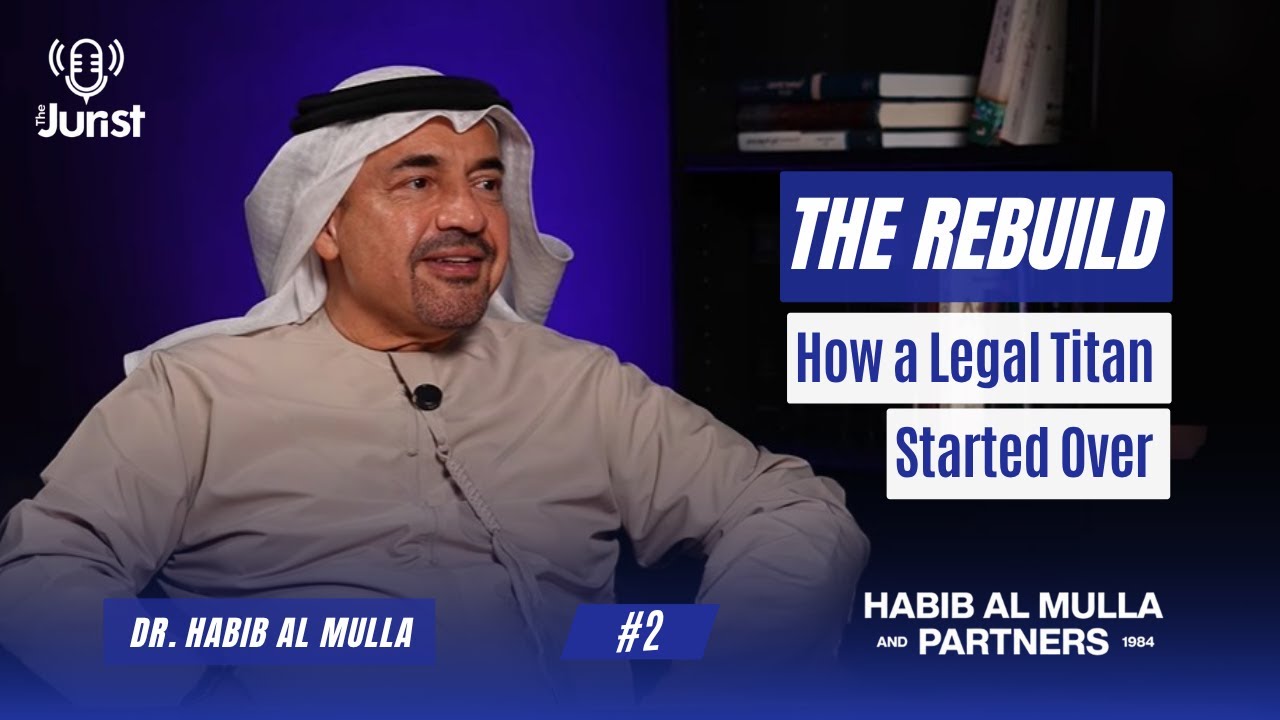
Welcome back to the jurist podcast. This
is the first episode that we shoot since
we started getting missiles and rockets
and drones and stuff that we've never
experienced and never heard of before
here in Dubai. We welcome for the second
time Dr. Habib Almulla. Thank you very
much and
>> thank you for hosting me.
>> Thank you very much for coming and for
your time. We know that you are very
busy and very uh occupied with a lot of
media and everybody is asking you so
many questions and I actually chose to
ask you a completely different question
today.
Is international law dead?
What's going on?
The short answer is no.
But its credibility
has been eroding.
I don't think we are seeing the collapse
of international law. I mean the rules
exist.
The institutions are still functioning.
But in my opinion, the real issue is not
the violation
of the law. It's the selective
enforcement.
What we are witnessing is
a set of law that is being applied when
convenient
and ignored when costly.
So we are moving from a system that is
based on rule to a system that is based
on power
and I believe that is the issue that we
are facing with international law.
It's quite significant to
witness such phase in the world. I mean
actually we what we learned at at law
school that the rule of law and the
spirit of the law and justice and
equality and seeing now that selectively
the rules are applied is is not
something that we can take lightly as
lawyers. How do you feel about this as a
lawyer? because I understand that you
practice every day and still go to court
uh besides all the management that
you're doing and you speak to and to the
other younger lawyers and you mentor
them. How do you feel
how easy it is to just say that we
protect the law but in practice we see
this happening in the world? Yeah, it's
not frankly it's not an easy thing. I
mean I can feel the frustration
that the public in general are seeing
today. I mean whenever I post something
and say well the international law says
so an article this of the United Nations
charter and the commission on
international law and I get comments
like uh it doesn't exist uh it's useless
doesn't apply to certain players.
Uh but that's correct but that has been
the case. I mean people I think tend to
forget that that has been the case not
today not since the UN was formed but
even during the League of Nations and
even before that whoever has power can
to some extent manipulate
the law international law. Now does this
mean that we don't need it?
No, at the end of the day, you see that
even
super cars like the US when it wants
sometimes to do certain acts,
it goes to the United Nation, it gets a
security council resolution, it meets
that legitimacy.
If we can put this into a form of
resemblance
uh and for people who understand or have
read the history
uh we have the Ambassi dynasty that
ruled for 500 years and historians
divided into two parts. The first part
where it was strong and powerful and
then the second part where it was it
existed but it was weak.
During the second part, there were other
strong players who were actually
managing the Arab the Islamic world, the
Saljuk at one time, the at another time.
But still
the Friday prayers were called under the
name of the Khalif.
The war were declared under his name.
They always needed his blessings to do
any act because he provided legitimacy.
Although in reality he had no power. I
think that is a good resemblance of what
international law plays today.
I I I now I'm getting to get the
picture. But I want to ask you now we
are not even in a situation where the
war is declared. So let's go back to the
legal side. We put the emotions What is
the situation right now? How does the
international law classified an armed
conflict without a declaration of war?
Okay, I mean technically
there is no war. War has not been
declared. If you declare war, there are
certain actions and certain
consequences. for example,
uh general mobilization,
uh martial law could be applied, uh wide
powers for the executive. We don't see
any of that.
But in reality
uh continuous
use of force
constitute an armed conflict
irrespective of what the players label
it war or otherwise. So I don't think
the labeling is important but what the
civilian population
are suffering from or are facing is the
relevant point irrespective of what
labels we put it war armed conflict
special operation I think that's
irrelevant I think here in the UAE also
as as you mentioned the civilians we
always felt that we are a neutral party
we don't getting conflicts in around the
world. We always thought that we here in
the UAE are focused on life and we want
to create good stuff and want to create
good future and we feel that we are
neutral but on a legality on on a legal
uh side. What determines whether a state
is illegally neutral to a certain
conflict because I feel that we are not
part of this conflict between the US and
Iran. I I think what you are trying to
hint to or indirectly ask is whether
hosting US military bases makes
uh the Gulf countries or you in
particular
to this conflict. I
>> I have an opinion about that but I would
like to know yours.
>> Yeah, the simple answer is no. And
that's not an opinion. That's the stand
of international law. the International
Law Commission and the International
Court of Justice in a famous case of uh
Nicaragua
uh put a threshold
that the passive hosting of military
bases particularly when these military
bases were hosted prior to the conflict.
So that timing is of importance
and particularly when there is no any
operational command on these bases
does not make the hosting state a party
to the conflict.
Now I know Iran is saying otherwise but
let us take Iran's argument to its
conclusion.
If we adopt
what Iran is saying, it means that any
country in the world which is hosting a
US military base and there are many
around the world is a party to any war
that the US declares and I mean this
kind of argument doesn't it it collapse
it destroys the whole concept of
international law and has no legal
background. The US has more than 750
military bases around the world in more
than 150 countries. So I that's exactly
my opinion is like if if you are going
to blame one state because they have a
military base there, you're going to
have to blame 150 countries for every
single war or armed conflict that the US
is going to, which makes absolutely no
sense. totally agree and I understand
but to be very honest I I'm let's say
the normal person who's living his life
they don't really care about the
politics and they don't care about the
moving um parties in any political
conflict
we as civilians um
care about the infrastructure where we
live care about our personal um
interests and I can't travel because of
an armed conflict. I was um hosted uh by
uh by a Ukrainian you um YouTuber who
lives in Ukraine. He's a 33
years old gentleman and he is not part
in any conflict and he's not military
guy. He's just a business guy and he
cannot travel because the laws in
Ukraine uh disallow him from traveling
if he's between the age of a certain
bracket and he's healthy because he can
be anytime mobilized. So what I really
I'm asking do these attacks on civilians
and strategic infrastructure qualify as
an armed attack under the international
law? Can I as a civilian
have the right to object on such things
because it really affects me? Yeah. Uh
see the stand of international law is
very clear
according to the additional protocol of
the Geneva Conventions.
Any attack on objects that are
indispensable for the survival of
civilians is a violation of
international law.
Uh for example, attacks on power plants,
uh water systems, food supplies.
In addition to that,
the
intentional
targeting of infrastructure which are
purely civilian in nature
that are not being used for any military
activities like ports, airports and so
forth constitutes even a war crime under
the room statute. So the stand of
international law is very clear. What
Iran has been doing is a violation of
international law. Is an act of
aggression. You even even if and I'm
saying a big if here. Even if
Gulf countries
were party to this conflict,
you cannot
categorically
target civilian infrastructure.
Period. Can a state be held legally
liable or responsible to the actions of
another state
which it maintains
political and diplomatic relations with?
Am I at any point going to be held
liable to the actions of any country
that I have diplomatic relations for? So
if I don't know tomorrow uh Egypt went
to war against Libya, is the UAE going
to be held liable because Egypt and the
UAE have diplomatic relations? Is this
normal? Absolutely not. Uh diplomatic
relations when states are at war at most
may may cause reputational damage.
That's if we take that argument to the
extreme.
But legal liability absolutely not. And
I I think again the argument uh that
Iran is posing is unsubstantiated has no
legal feat whatsoever. I'm going to ask
you the question in a different way.
Same but it will give a different
message.
If a state normalizes relations with
another state, does that make it morally
or legally responsible for everything or
anything that the other state do? Again,
no, absolutely not. So, what what's
wrong with
the Arabic media narrative? Because
I don't know, are we singled out here?
Because this I also see other media
outlets in the Arab region who are
siding with the wrong
uh party in this conflict with the
aggressor just because we have
normalized or here in the UAE we have
normalized relations with another party
both of them are in conflict there are
two answers I think which or or two
points that I need to clarify here let
us take it the first one and then I'll
come to the second uh heart
two wrongs don't make right.
Uh the problem I think with or the
problem the argument that some present
here that as long as you are attacking
Israel everything else you do is right.
So if I criticize Israel, if I bombard
Israel, then that makes whitens all my
other actions. And this kind of argument
I can't I mean even comprehend that
comes from scholars,
forget the common people, media outlets.
I mean it's like saying in in in private
law that for example if you can if you
kill a thief you have the right that
justifies you to cause whatever damage
you want to any other people for from
theft
killing raping everything is I mean that
is wrong this is wrong exactly one wrong
does not make the other one Right. So
that's the the the first one. Coming to
your question with regard to the
diplomatic relations and I think maybe
you're referring to the Abraham Accords.
Abraham Accords
creates
diplomatic relations, not security
obligations.
And that's clear. But of course, in a
midst of all this turmoil, particularly
when a country like Iran
understands that what it is doing is
wrong, legally wrong, morally wrong. It
just tried to throw any kind of argument
in order that to mix the cards and
confuse the people and say, "Oh, UI has
uh ties with Israel, so it has to be
bad." Uh they are hosting uh US military
bases, so we have the right to target
them. It it's it's bizarre that the
arguments that are being presented is
bizarre. And I have to say I have never
expected that respectable media outlets
in this region would even consider this
kind of argument. Since you mentioned
the Abraham Accord, I would like to know
what did we sign up for? I know we have
an embassy and they have an embassy and
there are diplomatic relations with
Israel, but what did we really sign up
for?
As I said basically diplomatic relations
uh certain economic ties, cooperation
and irrespective whether you agree with
that approach or not
uh UI has a narrative and I think in my
opinion they did not manage to uh sell
this narrative properly. Uh from the
UI's point of view, we have been in war
with Israel since 1948
and it led to nothing. Every time we are
losing more land. Uh the Palestinian
people are the most people who are
suffering because of this situation.
And the narrative is simple.
This
road has failed. Why not try this route?
Let us try it. Let us build economic
ties with Israel. Let have let Israel
has certain economic interest in the
region in the stability of the region
which would ultimately at one point will
lead to a situation where a kind of a
solution would be found. Now it has been
only a few years that this route has
taken place. So we have not seen the
outcome of this narrative and this path
yet but it's something that could be
tried. Uh now whether it's right whether
it's wrong
it's a different story. I mean time will
tell 50 years of war was wrong. not
accepting the UN the first resolution on
the division of the land of Palestine.
People today will say wrong, people at
that time thought rejecting it was the
right decision.
But I think time will will prove uh who
who was right and who was wrong. And I
think me personally in in general and I
do this with all my decisions, I might
be wrong. I might be actually wrong. But
I need to try and I need to try
everything. As long as my heart is in
the right place, my intentions are
positive and and and right, then I I'm
entitled to try everything. Um,
why is the UEE name being dragged into
all this? Why are we getting the most
hit?
Is it because geographically we exist in
this region? Is it because
my understanding is that we are doing
everything for peace and at the same
time we are doing everything for
business and we want to build life. We
want to build great economy and we are
winning. We want to build the best uh
buildings, the best tourism and the best
economy and we're winning in that as
well. And um we just exist here and we
are getting heat from both sides.
I think you nailed it. The fact that we
are winning, we are successful in let us
being number one. Uh I think it's a
mixture of jealousy,
hatred.
Uh
let us not forget
today we are not competing with regional
capitals. Today Dubai in particular is
competing with London and New York
period. I mean I was recent interview
and uh reporter a headline from New York
Times is this the end of Dubai. I mean
imagine New York Times half a page
headline.
>> Yes.
>> End of Dubai.
20 years ago if you have asked an
American citizen where is Dubai or told
him from Dubai he wouldn't recognize.
>> He didn't know.
>> He didn't know. So I think part of it is
that we are becoming the victims of our
success. We have been po posing a
serious threat to established capitals
like London. I mean it's not a secret.
People have been moving
in large numbers from London to Dubai
before this uh conflict started. I mean
we at our firm we were seeing like three
to four uh inquiries every week of
people trying to move to Dubai. Dubai
airport surpassed Heathro uh became
number one.
So of course I mean when you see this
and then suddenly something happens you
will bring out all your uh feelings. And
this is not the first time by the way
that this happened in the region. I mean
if again going back I think history is a
good example although it's in a
different context but again
you're Egyptian you know when Muhammad
Alibasha started building the Egyptian
army it's it was the beginning of what
we call the renaissance in Egypt and now
he expanded he became so powerful that
he was competing with France and the
colonial powers and England colonial
powers at that time and he was said oh
no no no this is too big you and grow
originally but to compete with us. No.
And they started attacking him and
trying bring him into the borders. I
think what UI has done is something
similar in its financial
uh sphere in its in its global uh
recognition.
And
I was that day with uh
uh the banker
and he had this weird idea or wild idea
I would say even that I think all this
war was created by the US to destroy the
recognition and the status of the UEE
because we became so successful, so
powerful financially.
that uh we started to pose a threat
that that's right or not. I think at
least both parties Iran and some uh
media outlets in the west at least have
that wish. Iran from a this different
perspective I mean it's a failed state
apart from its military
damage that it can cause. So there is a
very successful model next to it. And of
course when you see this and you fear
that people will try to compare how
state huge state with all the resources,
population, education that of Iran is
living in this misery while you have a
small state that is so successful. West
of course from their envy.
Um I think the last 10 years have really
proven everything you're saying and it's
I don't even see it just the UAE I've
seen Qatar doing amazing work last 10
years Saudi uh Egypt and I've seen many
places even Bahrain in the in the last
10 years have developed a lot and it
made leaders like Muhammad bin Salman
saying that this is the new Middle East
sorry the Middle East is the new Europe
and uh and and huge
Emirati figures and the leaders of this
country have been around the world being
praised for what they did in in a very
short time. And yes, this conflict might
make a pose, but I always say it, no one
masters coming back like the UAE. True.
Honestly, I've seen it in 2008. I've
seen after 2008 and I've seen after
COVID and no one masters coming back
like United Arab Emirates.
>> Yes.
>> Um this will take me to another
question. Did you see this conflict
um getting the GCC countries closer? Do
we see more
unity in this crisis?
Definitely. I think we are seeing uh
more unity,
stronger bond between the GCC because I
think everyone feels that we're in the
same boat. The when the Iran's targeting
it doesn't differ between Kuwait, Oman,
Qatar, UAE, they are treating them all
as uh the same. Uh and I think also that
the GCC before this conflict is will not
be the same GCC after this conflict. I
think we'll see shift in policies,
directions.
Uh
but one thing I think uh this conflict
has proven
is that the GCC is stronger than what
everyone thought of. I mean I've heard
it myself many times that yes it's very
positive flourishing active but the
minute there is one bomb this is going
to be a ghost town.
And as we were talking last night, I was
going to a restaurant. I had to wait 20
minutes to get a table.
>> Yes.
>> Uh this has shown that people living in
the the residents I'm talking about the
national the residents.
>> Yeah.
>> Feel affiliated to this place. Many
chose not to leave. Many chose to stay.
That's one that the investment that the
country has done in its military
structure has proven useful at this
time. I mean
100% interception of missiles is
unprecedented. Yes, we had the issue
with the drones that's a different story
but missiles 100% interception. I think
that's by any record is an outstanding
uh achievement and it showed that there
is stronger than what it looked on its
surface. Are we looking at failure of
diplomacy? Do you think United Nations
is actually doing what it should do or
do you still believe in it and diplomacy
this is a proof that diplomacy must
prevail and must actually take place
United Nation
does what its players want it to do so
it doesn't act on its own I mean that's
the starting point I don't think it's
failure of diplomacy I mean as We talk
now there are discussions happening
between us and the Iranians and I think
they're meeting in Pakistan.
Uh in fact
again if you look into history the most
durable
settlements happened under intensive
conflicts. You have the Korean war for
example. You have the war between Iran
and Iraq.
uh when the uh battle was or the fights
were intensifying they had discussions
they had a settlement that is going till
today. So I think if this time if a
settlement is reached it will be a kind
of a sustained settlement that I think
everyone will benefit from. Do you
believe that the talks that is happening
right now might actually
uh
end this conflict? Yes. But
as analysts say, the parties need to
reach to what it is called hurting
mutual hurting stalemate
where both parties recognize that the
cost of continuing this conflict is
higher than reaching a settlement. And
until the parties reach that line or
cross that line, diplomatic efforts are
more of declarations rather than
solutions.
I'll take you to another uh topic
because I want to I want to go back to
legal because I asked you a little bit
too too many political questions. I've
seen the reaction of the western media
which I really am very disappointed
with. I've seen the reaction of the
tourists who uh came here to the UAE and
uh and u posted so many um I I don't
even want to say fake but some of them
are completely exaggerated
uh content and they were taken very
seriously by the western media and I've
seen fake news going on around and I've
seen the western media adopting and
taking these fake news and fake videos
and
what is their responsibility? I mean for
all the information, misinformation,
rumors and the biased statements against
Dubai in particular and the UAE in
general.
Are there no laws in UK to regulate
these guys? To be very honest, I mean,
I'm a bit offended of how freedom of
speech is really okay when you're
attacking everybody around you, but
freedom of speech has limits when you're
attacking uh the West.
Yeah. I mean, I fully agree with this uh
fake and I I would use the word fake
rather even exaggerated. I mean, uh, I
saw in a western media outlet, uh, a
video of a building being burned,
saying, "Oh,
uh, City Bank in Dubai is under fire."
>> I said, "I've never seen this building
of City Bank in Dubai.
>> Does it not exist here?"
>> It was a building in in Bahin.
Unfortunately
whether it's ignorance whether it's
intentional we have seen this trend and
I think even established media outlets
fill into it now when it's come to
responsibility
again international law is is clear if
uh media narrative
uh incite attack on civilians
or or civilian infrastructure
or dehumanize
civilians,
there could be a liability. And there is
a a very well-known case by the
International Court of Justice in uh
Rwanda's case where uh they media
outlets were charged because they were
in fact promoting a kind of even a
genocide.
>> Yes.
uh now whether that would be applicable
here I think it's a it's a different
question
uh but even if there is no legal
responsibility maybe has its own
responsibility I mean at the end of the
day if you want to gain people's
confidence and trust
you need to be credit worthy when you
spread rumors like this where you act
like I don't know populists
of course you lose credibility and I
think this is time for the GCC to
establish
uh solid media outlets that can
uh address the western audience. Katar I
think has been successful with Jazzer
and I think it is time for UEI and other
GCC countries to do the same.
Reflecting on the same point where
a media outlet
um exaggerate
and push the public view into a
direction that
hurts the UAE or hurts Dubai or hurts
any other GCC country in its economy
because we get affected by the I don't
know if if you're going to scare the
world from the situation here. Tourism
stop and this has economic effects.
Airlines stop because this has economic
effect. Me as a lawyer and you as well,
our work will stop because the
transactions and the deals and the
future of business in this region get
affected. We basically don't lose
reputation. We lose cash
on the short term. Can a private
enterprise or a company sue a media
outlet outside for tarnishing the
reputation of the country because we are
directly affected.
See this question in particular has I
think different angles too. Uh media
outlets can manipulate financial markets
and I think we have seen recently some
news about this timing of certain
decisions and in the media and how that
manipulated uh financial markets. It can
cause panic. Uh it can in fact even lead
to escalation of activities. some some
misinformation if it's spread for
example say oh UI is uh there is a
rocket coming out from the UI attacking
Iran it may lead to escalation
>> of course
>> so it has consequences
now whether those media outlets can be
held responsible I think it's a
different story has not been tested it
worth while testing it I think if
someone has been directly damaged
uh I think it's worth trying that route
and see if that principle can be
established because media has okay
freedom of speech no one is talking
about yes you have the right to do
freedom of speech but when you
>> intentionally
uh spread false information
uh which leads to damage then we go to
the basic rule of law wrongful act cause
>> cause and damage
>> yes Um,
capitalizing on this point, let's say
the the the the responsibility of the
media is questionable, but the
responsibility of the aggressor state is
not questionable. We see rockets,
missiles and drones coming out from a
specific state towards us and this
damage
is uh documented in many ways. what is
the responsibility
or how far can we held the state of the
aggressor
uh responsible of material damages
because we've seen civilians getting
affected. Yes. Again, we go to the basic
simple rule wrongful act. I think with
the pass of the United Nations uh
security council resolution lately that
condemned the acts of Iran being
aggression. I think the wrongful act has
been established.
Uh Iran is in violation of international
law by these attacks. So that part I
think now is solidly established.
There are two more things we need to one
is causation and the actual damage and I
have asked I think the way to do this
because the claims need to be done uh on
a level of state-to-state
an individual doesn't have a direct
claiming right so even individual rights
need to be
put in a file which the states adopts it
uh I've asked for uh the formation what
we call the national committee to assess
these damages to collect all the
evidences, calculate the damage, make
the standard uh applications for
individuals to submit it to
>> uh this committee and then you need to
take it to the next level of
seeking compensation. Now this can be
done in various uh routes. One is a
bilateral arrangement like what happened
between the US
uh Iran claims tribunal.
>> Yeah.
>> For the
hostages of the American embassy.
Most probably Iran will not accept or
not to concede to this. Then you have
two more options. one is going to the
security council obtain a resolution to
form a committee like what happened in
Kuwait and Iraq uh committee was formed
and I think they looked at like 26
million claims between state and
individuals.
>> Yeah.
>> And the other third thing would be to go
to the international court of justice to
establish Iran's uh liability. But I
think that is in my opinion going to
come. Uh the damage that Iran has caused
to the Gulf states is huge. I mean there
attacks on the gas installations in
Qatar on itself. Uh they have been
estimated more than 20 billion and then
if someone has to pay for that they have
to pay for that. I will tell you
honestly that's my opinion at least. Um
I think a few years ago I met a very
smart lawyer in um I was in a conference
in uh in Warso in Poland and he was
promoting
his services to private uh individuals
like individual um people who have been
affected by the attacks of the Russian
state uh in Ukraine. and he was
collecting these claims because there
are a tremendous amount of uh Russian
assets in Europe and they're able to
seize these assets. Going back to us
here in the UAE only, I'm not talking
about Bahrain and Qatar and Saudi
because there are Iranian assets or
Iranian
um state controlled assets in an
indirect way and I think we understand
each other when I say this. Um, can we
do the same here? Can people who got
affected directly start claims and can
we reach the level where the Iranian
state will be held accountable to its
action by seizing their controlled
assets in the region?
>> Yeah. See, it's not unprecedented. We
have seen seizure of uh Russian state
assets in Europe. We have seen seizure
of assets in Ukraine.
Uh in fact, Ukraine went even one step
further of confiscating
the assets, not just Caesar. Europe stop
short at seizure only. Now we have to
differentiate between three types of
assets. Assets that are stateowned and I
think there is no issue that those could
be seized. I'm not sure that Irania as a
state has any assets abroad. Then there
are assets for agencies
and institutions owned or companies
owned or controlled by the uh Iranian
government like for example uh bank that
is 100% owned by the Iranian state that
I think are where the most of the action
can come uh seizing those assets and
then you have assets of individual ual
Iranian individuals and I think neither
the UN or any other country want to
seize those assets. However, in Europe
in particular, they seize the assets of
individuals who are closely connected
with the Russian government. So I think
there is the area where we need to see
how we can evaluate that situation. But
in order to do this, you need either uh
rule from for example resolution from uh
security council or you need to pass a
national law as Ukraine did for example.
What are the legal remedies are
available for individuals and businesses
whose assets are affected by measures
targeting property directly or
indirectly linked with a foreign state
whether inside or outside the UAE.
As I said, these claims need to be
quantified by the state and put in a
file that the state will pursue it.
However, we have a president.
Canada passed a law. I think it's called
justice for the victims of terrorism.
So, how the system works?
The law has been passed.
There is there is a list
that the I think it's called the
governor.
The governor can add countries to that
list. And guess who's on that list? The
first country, Iran, of course.
And then individuals
can go to the Canadian courts. So the
jurisdiction was brought to the Canadian
courts and file a claim saying that we
are victims of an act that was sponsored
by Iran. And in fact, the Canadian court
s couple of cases. One attack for
example was
uh the heirs of uh someone who died
because of uh an attack by uh Hamas
and the court awarded saying that yes
Hamas is sponsored by Iran. So Iran is
spons responsible for actions of Hamas.
These are the victims and awarded them.
Now once you get that award you go to
the next stage of execution. if there
are assets in Canada for example. If
not, you can get a kind of what I would
call NAVA injunction. Let let me ask you
a question that a lot of uh UAE
residents like me and UAE nationals who
live here uh are asking themselves.
Should be we should we be worried about
our safety or about the business or
about the future here?
Short answer, straightforward, no. I
think uh uh the initial shock yes was a
shock. I mean we never thought that we
are going to be under rockets and
missiles and fire and so on.
>> But we have seen how the system
functions full interception institutions
work civil defense is there hospitals
all businesses governments properly
functioning. There was no interruption.
No, I mean in certain countries you may
find looting and collapse of rule of
law. Nothing of that happens. Zero.
Which show that it's an efficient
system. It's a solid system. It's
working. And I think people realize this
and they're going back to their normal
life. So there is nothing to worry
about. And what's your advice to
businessmen and business owners?
um what what should they do at this time
of crisis?
See the worst decision you can take is
to take a decision when you are under
panic
because then most likely if not 100%
your decision will be wrong and we have
seen in cases for example when certain
crisis happens in other jurisdictions
uh I'm talking about for example law
firms or companies that they immediately
start cutting uh their cost uh firing
people and then when things started
better they struggle to go back into
business again. I think what you need uh
to do is to have legal clarity. What are
your contracts? How are they uh
structured, organized? This you need to
have what I would call a financial
planning especially on the cash flow.
Okay, how much cash flow do I have?
Where there are the necessities? Where
are the non necessities? And I I I would
say also uh decent planning ahead. So
how do I need to work from home? I need
to work from the office. How I where are
the opportunities? And and believe me in
every
situation there are opportunities
whether it's a business, whether it's a
law firm, whether it's any kind, there
are always opportunities in these
situations. You know a few days ago I
made a video and um because I was
watching the western media with their
narratives and at the same time I was
watching even influencer videos who are
running away and say saying uh sell sell
your investments and stuff. So I made a
video and I said don't become our next
opportunity and I explained is that
people who run away at the times of
crisis they lose and this margin that
they lose becomes the opportunity for
the believers.
>> Exactly. who will stay and who will hire
this employee who got fired but he's a
great asset or who will buy this
property on 25 or 30% less because it's
going to bounce back because again no
one bounce back and come back better
than the UAE we master this game we know
how it works
>> we saw some strong public figures from
the GCC like Mr.
And he said something like why are we
dragged into this war and he was
addressing this statement to a specific
country which is United States of
America. Why are you dragging us to your
war? Uh what what do you what do you
think of this perspective as well? I
think Mr. Hapur's remarks are accurate
and correct. I mean this is a situation
that we were not consulted
uh we didn't participate and suddenly we
find ourselves in the midst of hostile
activities between two nations that got
nothing to do with it. At the end of the
day the US is a strategic partner for
the UAE. It will continue to be this. I
mean for various reason financially,
military uh technology wise and so on.
Iran is a neighboring country. I mean we
are governed by the rule of geography.
It's not going to disappear. We have
lived with Iran for
>> many many years and we'll continue to
live with it. Whether it's this regime,
whether it's a different regime, whether
it's the same regime with a different
direction. The only thing is that we ask
parties to abide by the law and to
respect
neighborhood, respect international law.
We have no bad intentions towards any
country and we don't want any country to
have bad intentions towards us. At the
end of the day, it is a very clear
message. We are a country that has a
very clear intention. We build for the
future. We
want businesses to flourish. We want
people to live peace peacefully and we
want people to live well and to enjoy
life and to have the best uh
infrastructure and the best life ever.
And the rule of law is very important
whether internal or external with our
neighbors or with our allies. And when
we succeed and when we win so big, we
sometimes get burned by our success as
you said. And this success can make
haters or envious uh media all around
whether from the east or from the west
or sometimes from people who are still
living among and around us and our
message is very clear. We do nothing
else but work and we are peacemakers and
we are life lovers and we would like to
continue our life in this way. Um my
final very hard question for you. What's
the lesson that we learned in the UAE
out of all this? I think the most
important lesson that uh we have learned
is that we need to be ready and I think
what the government has done that it was
ready for this day. When the day came,
we were ready. We absorbed it. We
protected our population. we protected
our country and I think that's the best
lesson that we all learned.
>> Dr. Habib, it's always a pleasure and
it's always an amazing insight that we
get from you. Your opinions are very
very valuable to us and to our audience
and um if you want to um give a message
to uh your team and to your family
during this hard time, please feel free.
I I think it was a third or fourth day
of this issue. Uh I had a meeting with
our whole own staff
and of course I assure them everything
is fine your safety is the most
important thing but then I told them one
thing in Arabic we have statement which
says
in a simple English there is always
opportunity and crisis. And I told him I
see this opportunity. I see this
practice of I see this that we are going
to benefit from. There are certain areas
that I can see from now that are
opportunities
for us. Those who decide to stay
in the long run they are going to
benefit.
Absolutely. And with this I uh thank you
very much again for coming and for being
with us. And this is uh the jurist
podcast. I hope you enjoy it. I hope you
benefit from it. And I hope you got some
assurance and some clarity whether on
the current situation or with the
legalities around it. If you have any
question to me or to Dr. Khabib, please
feel free to do that and please follow
the jurist podcast. Share what you like
uh of these statements and subscribe to
our channel if you want us to bring more
valuable successful leaders in the legal
field. Thank you very much.